Due Diligence for Business Partnerships: Beyond the Financials
McKinsey, Deloitte, and Harvard research shows 70% of M&A failures are caused by cultural incompatibility, not financials. A complete guide to human due diligence.
When you hear "due diligence," you probably think of auditing balance sheets, checking liabilities, and analyzing cash flows. And rightfully so — financial due diligence is essential. But research shows that the biggest risks in a business partnership are not hidden in the numbers — they are hidden in the people behind them.
This article explores human and behavioral due diligence — the dimension most entrepreneurs ignore when entering a partnership, and which is, paradoxically, the most important one.
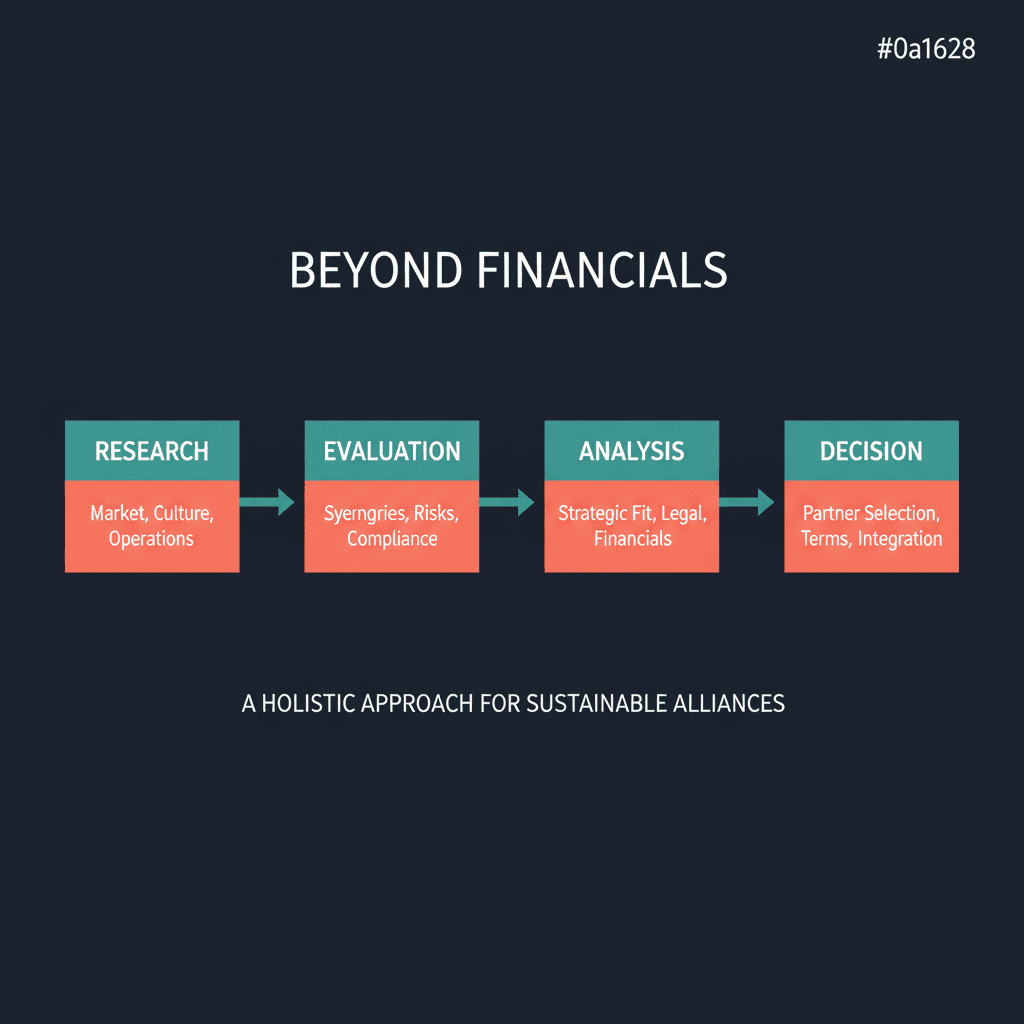
The problem: traditional due diligence leaves critical gaps
Professors Philippe Haspeslagh and David Jemison, in their landmark work "Managing Acquisitions: Creating Value Through Corporate Renewal" (1991, Free Press), demonstrated that acquisition success depends primarily on the ability to manage the integration process, not on financial analysis.
“Less effective acquisition decision making does not stem from a lack of analysis, but from problems in the acquisition process itself.”
Their research, based on case studies from 11 countries, showed that entrepreneurs and managers focus excessively on financial and legal due diligence, overlooking the factors that actually determine partnership success or failure: values alignment, decision-making style compatibility, and role clarity.
The due diligence gap
What academic research says: "human due diligence"
In 2007, Harvard Business Review published a foundational article titled "Human Due Diligence," which argued that evaluating leaders, organizational culture, and team dynamics should be as rigorous as financial evaluation.
Professors Sue Cartwright and Cary L. Cooper, in their research published in Academy of Management Executive (1993), were among the first to identify cultural compatibility as a key factor in the success or failure of mergers and partnerships.
“Many organizational alliances fail to meet expectations because the cultures of the partners are incompatible, despite selection decisions being generally driven by financial and strategic considerations.”
Cartwright & Cooper's research demonstrated that even when there is a high degree of cultural compatibility, the merger process remains a stressful life event with significant psychological impact. All the more so when compatibility has not been evaluated at all.
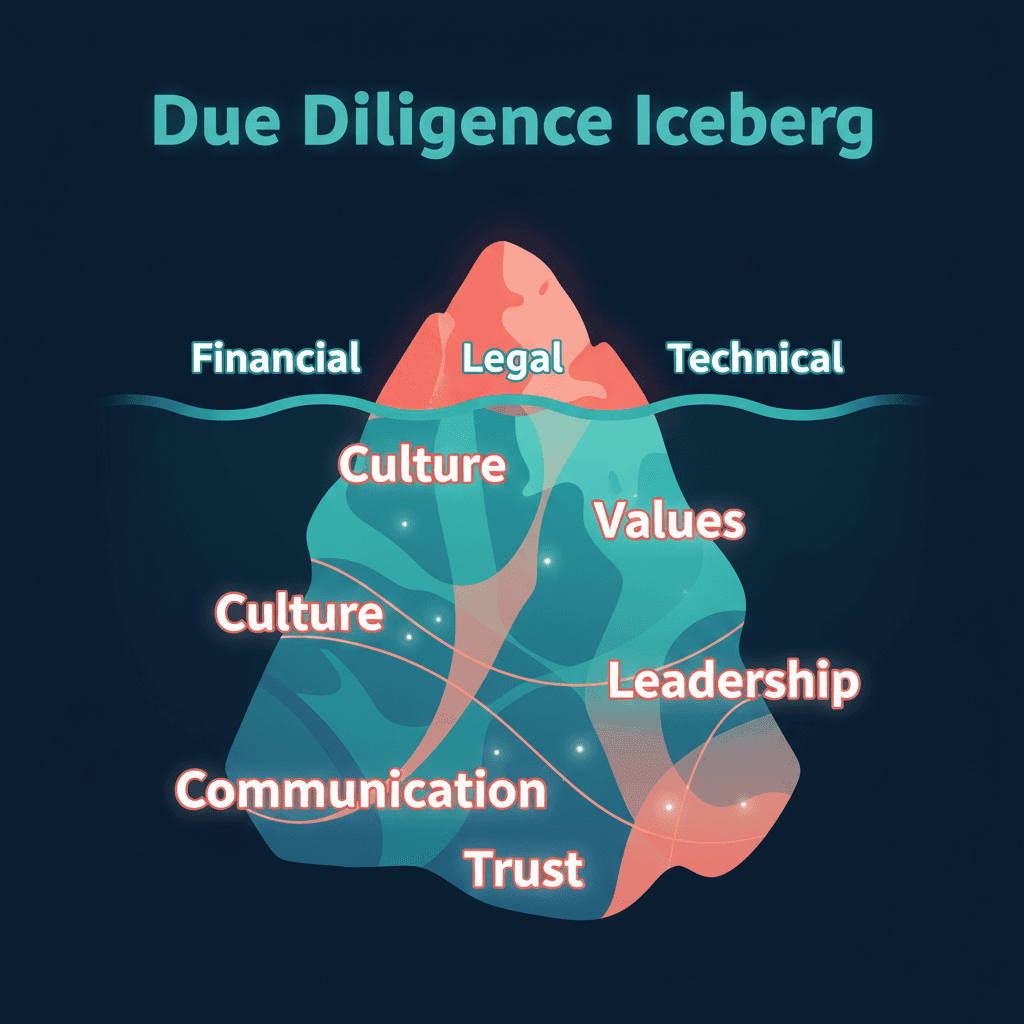
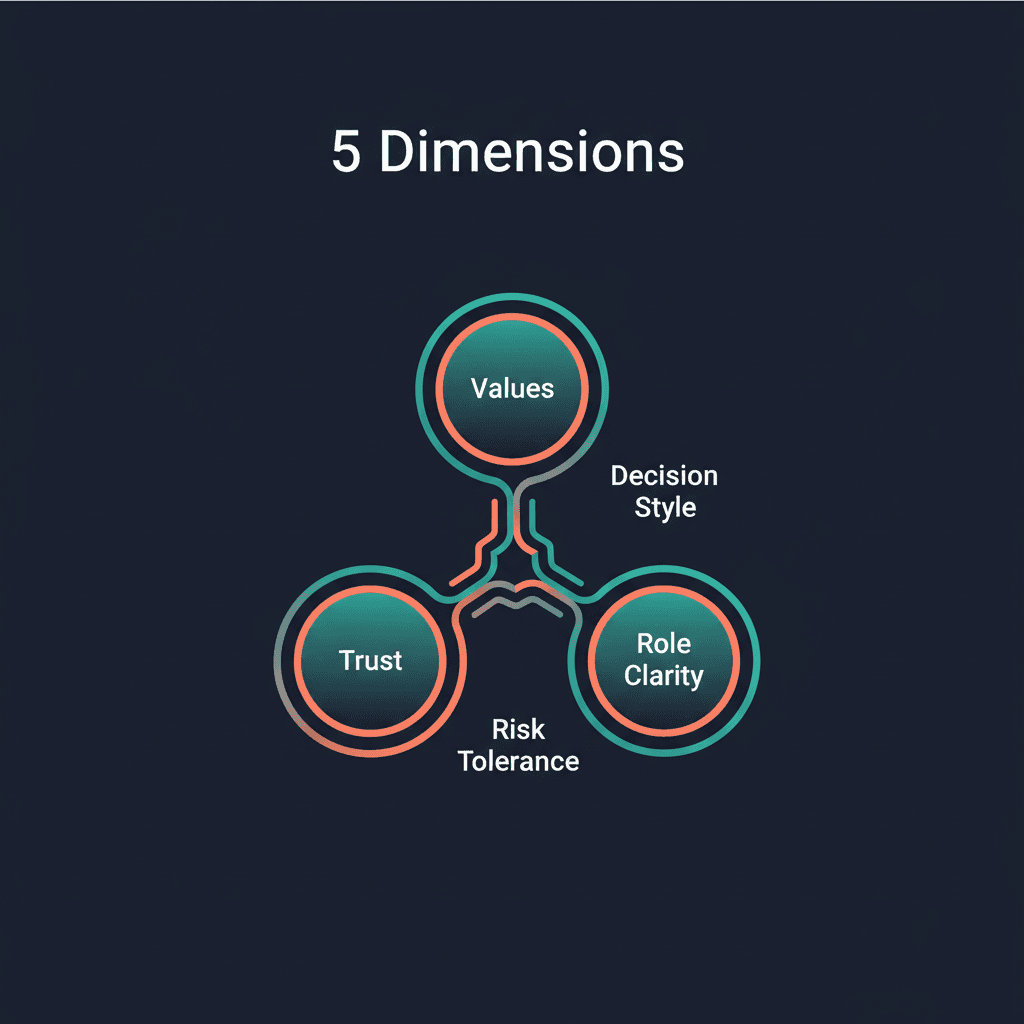
The 5 dimensions of human due diligence
Synthesizing academic research and consulting practice, we can identify 5 essential dimensions of due diligence that go beyond the numbers:
1. Values and vision alignment
Noam Wasserman's study at Harvard Business School, published in "The Founder's Dilemmas" (2012, Princeton University Press), analyzed over 10,000 founders and found that founders who do not proactively discuss vision are 2.6x more likely to separate.
Values do not just mean "what we write on the wall." They mean answering questions like:
- How aggressively do we want to grow?
- What compromises are we willing to make?
- What is the ultimate goal — lifestyle business, exit, legacy?
- How do we define "success" in 5 years?
2. Decision-making style compatibility
McKinsey's research on complex partnership management identified that disagreements over central objectives and governance processes are among the most common causes of failure.
Critical questions for this dimension:
- Who has the final say in which domain?
- How do we handle situations where we disagree?
- How fast do we move — deliberation vs. immediate action?
- What level of data do we need before making a decision?
3. Risk tolerance and financial mindset
Beyond financial capacity, attitude toward risk is a frequently underestimated compatibility factor. A partner who wants to reinvest everything and another who wants quarterly dividends will inevitably end up in conflict.
Case study
4. Role clarity and governance
Research on public-private partnerships, published in the Journal of Financial Management (2023), demonstrated that contract governance significantly influences partnership performance (Beta = 0.42, p < 0.001).
A solid partnership agreement should define:
- Clear roles and responsibilities for each partner
- Decision-making protocols and dispute resolution mechanisms
- Exit scenarios — what happens if a partner wants to leave?
- Adaptation mechanisms when market or circumstances change
5. Trust and communication
Industry research suggests that a significant proportion of business relationships dissolve due to a breakdown in trust. Partners who trust each other spend less time and energy protecting themselves from exploitation and achieve better economic outcomes in negotiations.
“Business partners who trust each other spend less time and energy protecting themselves from being exploited, and both sides achieve better economic outcomes in negotiations.”
Lessons from M&A: what we can learn from famous failures
The EY study on cultural performance in mergers showed that organizations investing in pre-deal cultural evaluation achieve significantly better results. In contrast, when incompatible organizational cultures merge, the financial impact is devastating.
These numbers come from large companies, but the principles apply equally well to small and medium partnerships. The difference is that a startup or SME cannot afford to lose years and resources discovering incompatibilities that could have been identified beforehand.
Daimler-Chrysler: a classic case study
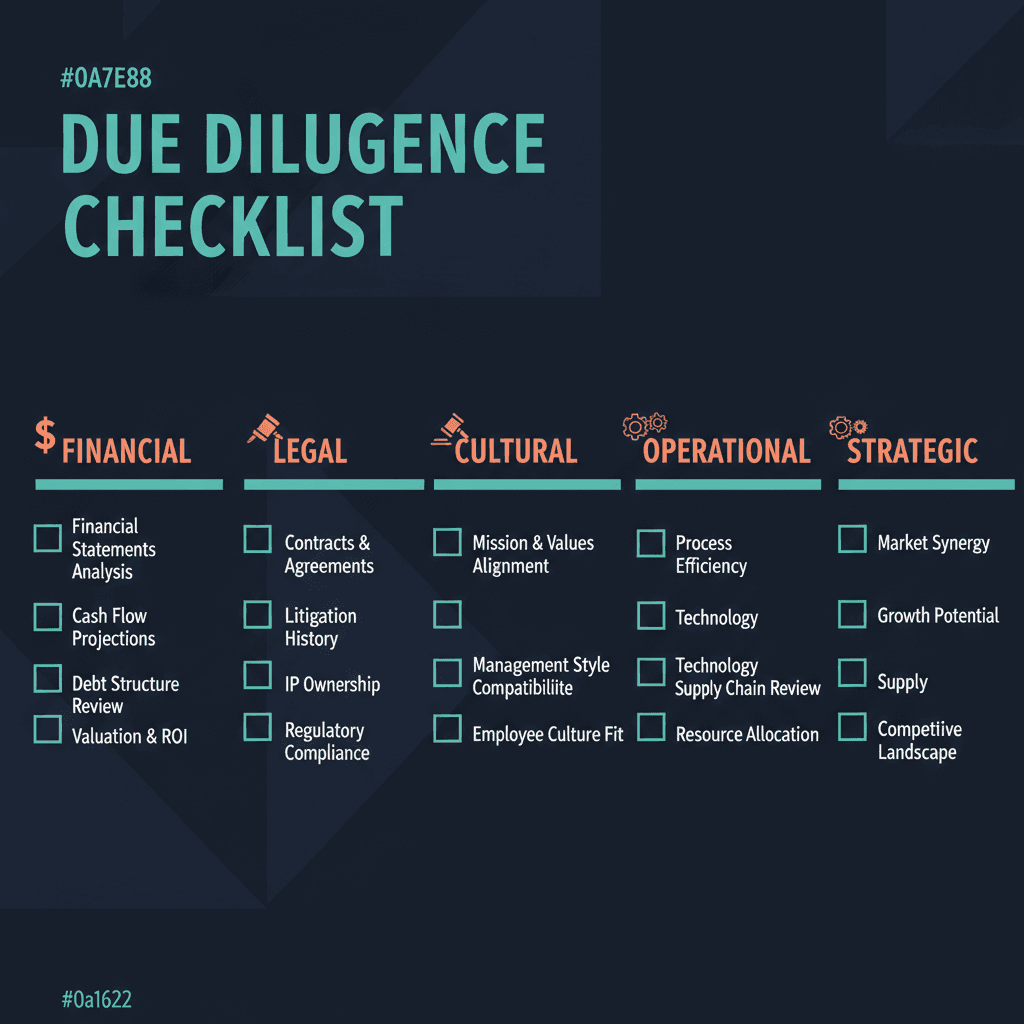
Practical checklist: human due diligence for your partner
Before signing any partnership agreement, go through these questions with your potential partner. Every "I don't know" or "we haven't thought about it" is a warning sign:
Values and vision
- Do we share the same definition of success?
- Do we agree on the desired growth pace?
- Have we discussed the exit scenario?
Decision-making style
- How do we make decisions when we disagree?
- Who has the final word and in which areas?
- What is the process when an urgent opportunity arises?
Behavioral financial aspects
- How do we split profits and when?
- What percentage do we reinvest vs. distribute?
- How comfortable are we with debt?
Roles and responsibilities
- Who does what, specifically?
- How do we handle responsibility overlaps?
- What happens if a partner does not deliver?
Trust and communication
- How often and how do we communicate?
- Can we have difficult conversations?
- Do we have a regular feedback mechanism?
The "prenuptial agreement" of business partnerships
Just as a prenuptial agreement does not mean you do not trust your partner, but that you respect the relationship enough to protect it, a well-structured partnership agreement is essential.
According to McKinsey research, partnerships with structured pre-deal evaluations have 30% higher success rates. And a study published in Review of Managerial Science (2024) confirmed that cultural distance, measured objectively, is a significant predictor of post-merger outcomes.
The message is clear: systematic compatibility evaluation before a partnership is not a luxury — it is a necessity.
How to start: from theory to practice
The research is clear, but implementation remains a challenge. How do you transform these academic principles into a practical, structured, and actionable evaluation?
Here are some guiding principles:
- Structure the conversation — do not rely on gut feelings. Use a systematic framework that covers all critical dimensions.
- Evaluate separately, compare together — each partner should respond independently, then compare answers.
- Look for differences, not just similarities — differences are not necessarily problems, but undiscussed differences are ticking time bombs.
- Document agreements — everything you discuss should end up in a written agreement.
- Review periodically — due diligence is not an event, it is an ongoing process.
Venn can help
Conclusions
Financial due diligence remains essential. But if you stop there, you are evaluating only half of the equation. The research of Haspeslagh & Jemison, Cartwright & Cooper, Wasserman, and others has repeatedly demonstrated that human factors — values, culture, decision-making style, and trust — are what determine whether a partnership will thrive or fail.
In a world where 60-70% of business alliances fail (Hughes & Weiss, HBR 2007), you cannot afford to ignore the human dimension. Complete due diligence means due diligence beyond the numbers.
References
- Haspeslagh, P.C. & Jemison, D.B. (1991). Managing Acquisitions: Creating Value Through Corporate Renewal. Free Press.
- Cartwright, S. & Cooper, C.L. (1993). The role of culture compatibility in successful organizational marriage. Academy of Management Executive.
- Wasserman, N. (2012). The Founder's Dilemmas. Princeton University Press.
- Bamford, J., Ernst, D. & Fubini, D. (2004). Launching a world-class joint venture. McKinsey Quarterly.
- Harvard Business Review (2007). Human Due Diligence.
- Hughes, J. & Weiss, J. (2007). Simple Rules for Making Alliances Work. Harvard Business Review.