How AI Improves Business Decision-Making: What the Research Shows
Research from MIT, Stanford, and McKinsey shows AI reduces cognitive bias and improves strategic decision quality. How this applies to partnership evaluation.
Business decisions are often influenced by cognitive biases we're not even aware of. Recent research shows that artificial intelligence can be a powerful tool for more objective decisions — especially when it comes to evaluating partnerships.
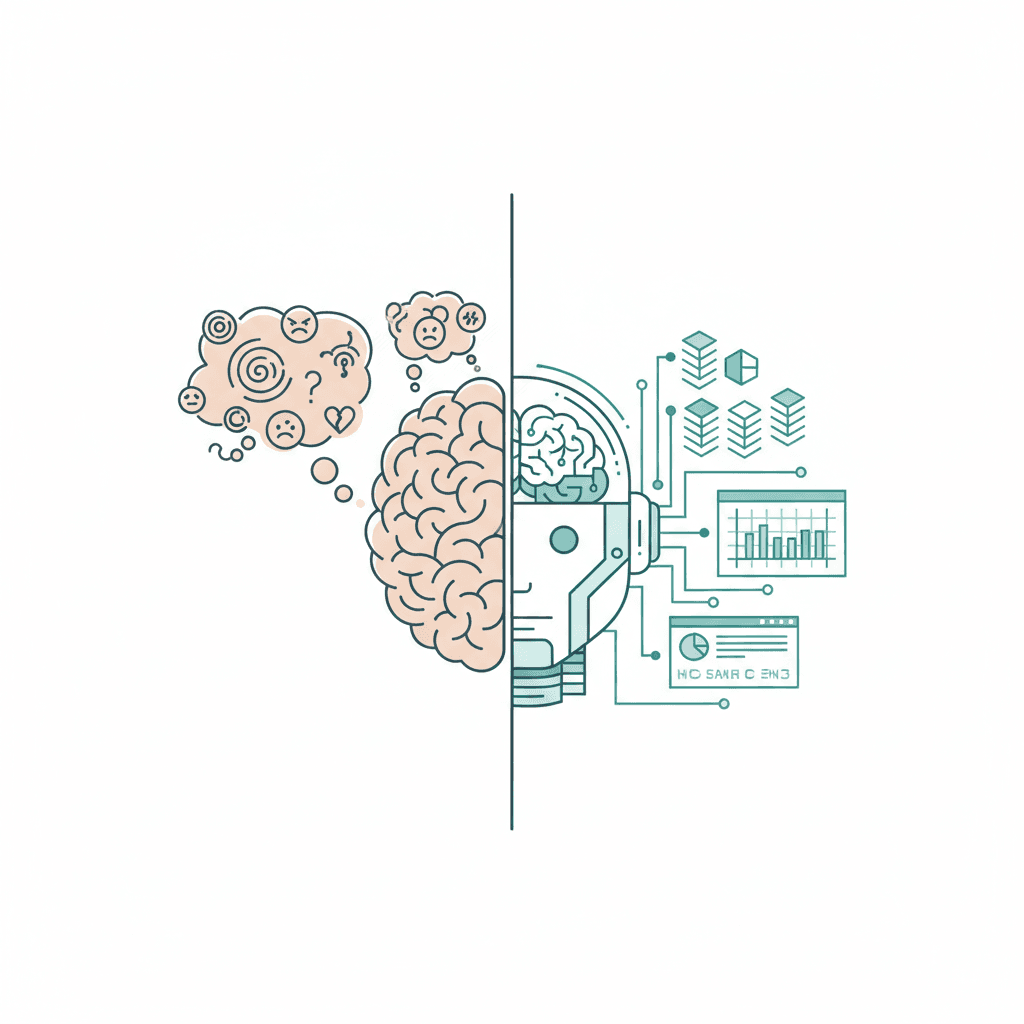
Cognitive Bias in Partnership Decisions
Research by Daniel Kahneman, Nobel laureate, documented in "Thinking, Fast and Slow" (2011), shows that business professionals are vulnerable to:
Confirmation Bias
We seek evidence that confirms what we already want to believe about a potential partner
Halo Effect
A single positive attribute (charisma, portfolio) makes us overestimate all other qualities
Anchoring Bias
The first information received about a partner disproportionately influences the final evaluation
Overconfidence Bias
We overestimate our ability to "read" people correctly
What Research Shows About AI and Decisions
A MIT Sloan Management Review study (Ransbotham et al., 2017) surveyed over 3,000 managers and found:
AI Can Evaluate Business Strategies at Investor Level
A study published in Strategy Science (Csaszar, Ketkar & Kim, 2024) compared AI evaluations with those of VC and angel investors:
Key Research Finding
Another field experiment from UW Foster / Harvard / MIT (Boussioux et al., 2024) — First Prize winner at Wharton People Analytics — demonstrated:
AI Advantages in Partnership Evaluation
Research by Davenport & Ronanki (2018), published in the Harvard Business Review, identifies three main advantages:
Consistency
AI applies the same criteria for every evaluation, without favoritism or fatigue
Comprehensiveness
Simultaneously analyzes multiple dimensions that the human brain processes sequentially
Objectivity
Not influenced by partner charisma or social pressure
“Expert entrepreneurs don't rely on predictions — they leverage available resources to create opportunities.”
Venn combines these principles: it uses AI to objectively analyze 6 compatibility dimensions, eliminating the cognitive biases that lead to failed partnerships.
References
- Kahneman, D. (2011). Thinking, Fast and Slow. Farrar, Straus and Giroux.
- Ransbotham, S., et al. (2017). Reshaping Business With Artificial Intelligence. MIT Sloan Management Review.
- Csaszar, F.A., Ketkar, H. & Kim, H. (2024). Artificial Intelligence and Strategic Decision-Making. Strategy Science, 9(4), 322-345.
- Boussioux, L. et al. (2024). AI-Assisted Decision-Making. Wharton People Analytics, First Prize.
- Davenport, T.H. & Ronanki, R. (2018). Artificial Intelligence for the Real World. Harvard Business Review, 96(1), 108-116.
- Sarasvathy, S.D. (2001). Causation and Effectuation. Academy of Management Review, 26(2), 243-263.